
Choosing the right Biology Dissection Kit is more than comparing prices and counting instruments. Global buyers must evaluate safety, teaching value, documentation, and supplier reliability together. A low-cost kit may look attractive online, yet poor steel quality can cause rusty forceps, loose handles, or inaccurate instruments. These small failures become obvious in a busy classroom.
Practical purchasing experience shows that details matter. Check whether the kit includes blunt probes, durable scissors, smooth forceps, protective gloves, and a secure storage case. Stainless steel tools should resist corrosion after supervised cleaning. Clear labels and simple instructions also help students work carefully. Packaging deserves attention. Foam inserts, sealed bags, and moisture protection can prevent damage during long-distance transport.
Rules vary by destination. Buyers should confirm customs requirements, product standards, age guidance, and restrictions on any preserved educational material before placing an order. Reliable suppliers should provide material information, safety data, inspection records, and responsive after-sales support. Do not accept vague promises. Ask for sample photos, packing details, and a written quality standard.
No checklist is perfect. A kit suitable for a university laboratory may overwhelm younger learners. A classroom pack may not satisfy advanced anatomy courses. This guide presents ten practical buying tips for schools, distributors, laboratories, and international educators. It focuses on evidence, responsible sourcing, and real classroom use. Some recommendations may need adjustment. Local regulations, budgets, and teaching goals should always shape the final decision.
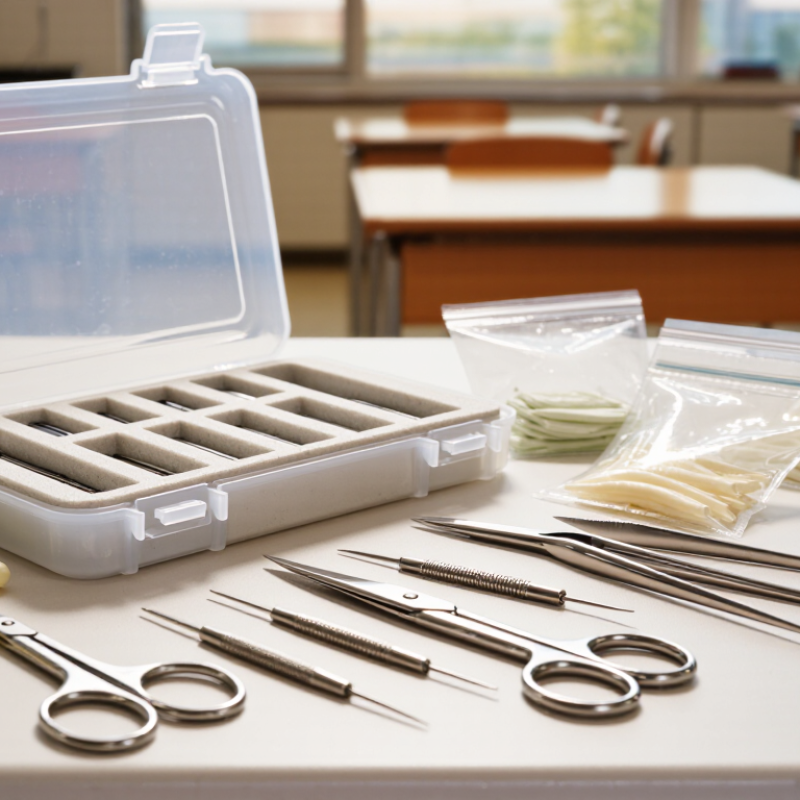
Define the kit before comparing prices. A frog model, a plant specimen, and a mammalian organ require different tools, safety controls, and preparation time. For beginners, choose blunt probes, rounded scissors, plastic forceps, trays, and clear task cards. These reduce handling errors and support supervised observation. Advanced learners may need sharper instruments, dissecting needles, magnifiers, and measurement tools. More tools do not always mean better learning.
The Education Endowment Foundation’s Teaching and Learning Toolkit reports that practical science approaches can support about four additional months of progress, based on reviewed classroom evidence. However, the result depends on guidance, not equipment alone. A crowded kit can distract learners. I have seen students spend more time sorting instruments than examining structure. That is a design failure, not a learner failure.
Tips: Map every tool to one task and learner level. Check whether a 12-year-old can hold it safely and identify it correctly. For primary classes, prioritize visibility and control. For university work, add precision tools and specimen-specific accessories. Ask suppliers for material details, replacement rates, cleaning instructions, and independent safety documentation. The OECD’s PISA 2022 science framework emphasizes explaining evidence and interpreting data, so include rulers, labels, and recording sheets, not only cutting instruments. A useful kit may feel incomplete at first. That can be healthier than buying complexity students cannot use.

When buying a biology dissection kit, compare steel grades before counting instruments. AISI 304 stainless steel contains chromium and nickel, offering reliable resistance in routine classroom environments. AISI 316 adds molybdenum, which improves protection against chloride exposure from saline, sweat, and coastal storage. ISO 15510 provides a useful chemical reference for comparing stainless steel compositions.
AISI 420 and 440A are harder martensitic grades. They can hold sharp edges well, but their corrosion resistance is usually lower than 304 or 316. AISI 420 may suit blades and forceps requiring hardness. It needs careful drying after washing. AISI 440A offers higher carbon content, yet hardness does not mean immunity from rust. A shiny surface can mislead.
The NACE IMPACT study estimated global corrosion costs at about 3.4% of worldwide GDP in 2013. It also reported that 15–35% of corrosion costs could be avoided through better practices. This supports checking passivation, surface finishing, and cleaning instructions, not only the grade. ASTM A967 is commonly referenced for stainless-steel chemical passivation. Ask suppliers for material certificates and test methods. Also inspect hinges, serrations, and screw joints, where moisture remains trapped. In my experience, these small areas fail first. I would still request salt-spray data, although it cannot perfectly predict classroom use. The wrong test can create false confidence. For global purchasing, compare AISI grade, corrosion environment, sterilization cycle, certificate traceability, and replacement availability together.
Screen every material against REACH’s 0.1% SVHC communication threshold. This limit applies to each article, not the complete kit. Check trays, tubing, foam pads, adhesives, coatings, pigments, and molded handles separately.
A tiny black grip may contain more compliance risk than the main plastic tray. Request the material composition, Candidate List screening date, and supplier declaration for every component.
The European Chemicals Agency’s Candidate List contained 241 substances in its June 2024 update. It can change as new substances are identified.
ECHA’s 2022 enforcement project reported non-compliance in 23% of inspected products. Supplier paperwork helps, but it is not proof.
Ask for laboratory testing when formulations are complex, recycled, colored, or frequently changed. XRF can screen some elements, while targeted chemical analysis may be needed for plasticizers, flame retardants, or adhesives.
Record the article weight, test method, laboratory date, supplier identity, and production lot. Keep evidence ready for EU importers and downstream users.
If an SVHC exceeds 0.1% by weight, provide safe-use information and check applicable SCIP duties.
Do not rely on an old declaration. That is an easy mistake.
Materials can change after a factory reformulates glue or pigment.
ECHA guidance and the REACH Regulation should remain the controlling references, not a general “REACH compliant” label.
When buying biology dissection kits globally, verify every chemical through a current, GHS-compliant 16-section Safety Data Sheet (SDS). A product page is not enough. Request the SDS before payment, then check the product name, concentration, revision date, supplier contact, and emergency information. Sections 2, 3, 8, 10, 13, 14, and 15 deserve close attention. They cover hazards, ingredients, exposure controls, stability, disposal, transport, and regulatory details.
The United Nations Globally Harmonized System specifies 16 SDS sections, but local implementation can differ. Therefore, a document may look complete yet remain unsuitable for your destination. Check language requirements and verify whether the importer needs additional labeling. The OECD’s Global Chemicals Outlook II projects chemical production could nearly double by 2030, increasing pressure on supply-chain controls. ECHA enforcement data has also reported substantial non-compliance in chemical labeling and SDS information. Small omissions matter.
For classroom specimens, confirm preservatives and stains are clearly identified. Ask for compatible storage temperatures and spill-response instructions. Do not accept “non-hazardous” as a substitute for evidence. Experienced buyers compare the SDS with the container label and packing list. I have seen mismatched concentrations create avoidable delays. That mistake is easy to miss. Review the document again after delivery. SDS files can become outdated, and my earlier checks were not always strict enough.
When buying biology dissection kits globally, supplier quality checks should use a clear AQL plan. AQL 1.5 is stricter than AQL 2.5. It allows fewer defects during sampling. For higher-risk items, such as blades, forceps, and needles, request tighter inspection controls. Check sharp edges, corrosion, loose handles, and missing components. A clean inspection table matters. So does good lighting.
AQL does not mean every unit is perfect. It is a sampling method, not a guarantee. Ask the supplier to define lot size, sample quantity, inspection level, and acceptance numbers before production. AQL 1.5 may suit precision tools, while AQL 2.5 can fit lower-risk accessories. However, this depends on product use and buyer expectations. Some suppliers present attractive reports but provide weak defect photos. That deserves a question.
Tips: Compare the inspection report with carton labels and packing lists. Request random samples from sealed cartons, not handpicked pieces. Test scissors, trays, and storage boxes during a live inspection. Record scratches, bent parts, stains, and quantity errors separately. Treat safety-related defects as unacceptable, even when the AQL result passes. Keep dated photos and signed findings for traceability. Do not rely on one inspection only. A second check may reveal packing damage missed at the factory. Mistakes still happen, especially with mixed-language specifications. Clear drawings and bilingual checklists reduce that risk.
| No. | Buying Checkpoint | Recommended Specification | Supplier Quality Evidence | Suggested AQL | Acceptance Criteria | Global Buyer Action |
|---|---|---|---|---|---|---|
| 1 | Confirm the complete kit configuration | Define the exact quantity and type of instruments, tray, storage case, instruction sheet, and permitted specimen accessories before ordering. | Approved bill of materials, itemized packing list, controlled product drawing, and pre-shipment carton photographs. | Critical: 1.5 | No missing, substituted, or extra functional components. Any missing component is a major or critical nonconformity according to the buyer’s classification. | Approve a golden sample and require written approval for every configuration change. |
| 2 | Check instrument material and corrosion resistance | Use corrosion-resistant stainless steel for forceps, scissors, probes, and dissecting needles; specify the material grade in the purchase specification where applicable. | Material declaration, supplier mill certificate or test report for the purchased batch, and visual inspection after cleaning and drying. | Major: 2.5 | No red rust, deep pitting, flaking plating, sharp burrs, or contamination. Hinged instruments must open and close without binding. | Request the material declaration and perform a wipe, hinge, and visual corrosion check on sampled units. |
| 3 | Verify cutting and gripping performance | Scissors should cut the specified test material continuously; forceps should align at the tips and grip without excessive side play. | Functional inspection record using a defined test material, plus measurement of tip alignment and jaw closure where relevant. | Major: 1.5 | No failed cut, snagging, misaligned tips, loose joints, or excessive force required for normal classroom use. | Include functional testing in the inspection checklist instead of relying only on appearance. |
| 4 | Inspect sharp edges, points, and user safety | Working edges must be sharp enough for the intended educational task, while handles, caps, and non-working surfaces must not have hazardous burrs or exposed sharp edges. | Physical safety inspection, protective-cap check, risk assessment, and product safety documentation for the destination market. | Critical: 1.5 | Reject any exposed unintended sharp edge, detached protective cap, cracked handle, or component that creates a foreseeable injury hazard. | Define safety defects separately from cosmetic defects and apply stricter release control to them. |
| 5 | Measure dimensions and interchangeability | Set tolerances for instrument length, handle diameter, tray compartments, storage-case fit, and any replaceable components on the approved drawing. | Calibrated caliper measurements, approved technical drawing, and a fit test for the case, tray, and instrument holders. | Major: 2.5 | All measured dimensions remain within the agreed tolerance. Instruments must fit designated holders without force or excessive looseness. | Record actual measurements and do not accept “equivalent” sizes without written approval. |
| 6 | Evaluate tray, case, and packaging durability | Tray and case should resist normal handling, close securely, protect pointed instruments, and provide ventilation or drying access when required by the design. | Closure-cycle test, drop or handling test based on the agreed packaging specification, and carton compression or transit validation when applicable. | Major: 2.5 | No broken hinges, open closures, cracked trays, exposed points, collapsed cartons, or packaging damage that affects product usability. | Specify export-carton dimensions, gross weight, moisture protection, and palletization requirements. |
| 7 | Review cleanliness and residue control | Instruments should be free from oil film, metal particles, polishing compound, dust, and visible biological or chemical residue before packing. | White-cloth wipe test, visual inspection under suitable lighting, cleaning procedure, and batch sanitation records. | Critical: 1.5 | No visible residue, loose particles, foul odor, mold, or contamination that could transfer during classroom handling. | Clarify that educational dissection kits are not automatically sterile unless sterility is specifically contracted and validated. |
| 8 | Control labels, instructions, and language | Labels should identify contents, handling warnings, cleaning guidance, country-of-origin information where required, and traceability details in the agreed languages. | Approved artwork, proofreading record, barcode or lot-code verification, and a controlled multilingual instruction file. | Major: 2.5 | No incorrect warning, unreadable text, wrong language version, missing lot code, or mismatch between label and actual contents. | Check destination-country labeling and consumer-product requirements before mass production. |
| 9 | Confirm specimen and chemical compliance | If preserved specimens, fixatives, stains, or other substances are included, define the exact contents, concentration, safety data, transport classification, and legal sourcing requirements. | Safety Data Sheets, ingredient or preservative declaration, packaging documents, legal-origin records, and transport compliance documents where applicable. | Critical: 1.5 | No undeclared chemical, leaking container, prohibited specimen, incorrect hazard label, or documentation gap that prevents lawful import or safe use. | Obtain written import approval and use non-specimen alternatives where local rules restrict biological materials. |
| 10 | Use a documented pre-shipment AQL inspection | Apply ISO 2859-1 or an equivalent agreed sampling procedure, normally using normal inspection and a defined inspection level. AQL is a sampling parameter, not a guarantee of zero defects. | Inspection report showing lot size, sample-size code, sample quantity, defect classification, defect counts, photographs, and final disposition. | Critical 1.5 Major 2.5 | Accept or reject strictly according to the selected standard table and contract. Any critical defect should be treated as unacceptable unless the buyer has explicitly defined otherwise. | State the standard, inspection level, defect definitions, re-inspection policy, and corrective-action requirement in the purchase order. |
We serve the Greater Milwaukee area: Waukesha, Milwaukee, Washington, Ozaukee Counties and nearby areas, including Germantown, Menomonee Falls, Mequon, Cedarburg, Thiensville, Grafton, Jackson, West Bend, Hartland, Waukesha, Brookfield, West Allis, Franklin, Greenfield and more. We are Wisconsin’s Best Contractor for Replacement Windows, Doors, Siding & Roofing!
Address:
N112 W14880 Mequon Road
Germantown, Wisconsin 53022
Phone:
Email:
Monday: 9am – 5pm
Tuesday: 9am – 5pm
Wednesday: 9am – 5pm
Thursday: 9am – 5pm
Friday: 9am – 4:30 pm
Saturday by Appointment
Evenings by Appointment