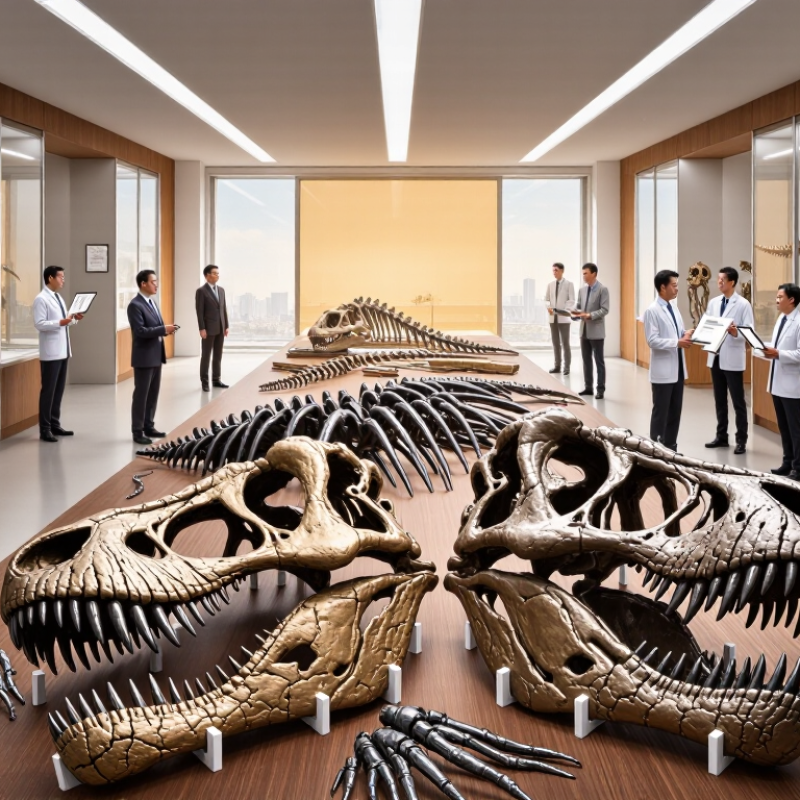
China Top 10 Dinosaur Fossil Suppliers for Global Buyers explores a specialized market shaped by science, craftsmanship, and strict documentation. Dinosaur Fossils are not ordinary commercial products. Each specimen carries geological information, regional history, and potential research value. Buyers should examine provenance, preparation methods, ownership records, and export permissions before discussing price.
Paleontologist Dr. Xu Xing has described China as “a treasure house of dinosaur fossils.” His observation reflects the country’s remarkable fossil diversity and continuing scientific discoveries. However, abundance does not guarantee reliability. A polished slab may look impressive under bright showroom lights, while hidden repairs remain difficult to detect. Professional suppliers should provide clear photographs, locality information, restoration disclosures, and written invoices. These details help museums, universities, collectors, and educational institutions make responsible decisions.
This guide introduces ten notable Chinese suppliers and explains the strengths that may distinguish them. Some focus on museum-grade specimens. Others offer replicas, educational displays, or carefully prepared fragments. The ranking is not absolute. Supplier quality can change, and online information may remain incomplete. That is worth remembering.
International buyers must also consider customs rules, cultural heritage regulations, and scientific ethics in their destination countries. Legal compliance protects both the buyer and the fossil community. It also discourages undocumented trade and misleading claims. A dependable supplier should welcome questions rather than pressure customers into quick payment. Experience matters, but evidence matters more. This overview aims to provide practical comparisons, while encouraging every buyer to verify current records independently.
China’s Top 10 Dinosaur Fossil Suppliers list evaluates documented expertise, product transparency, export experience, and professional communication. The ranking does not rely on advertising claims alone. It compares public business records, exhibition information, published catalogs, buyer reviews, and responses to verification questions.
Evidence matters most. Suppliers should provide specimen descriptions, geological age, locality details, restoration notes, and clear photographs. For valuable pieces, independent identification and lawful provenance records add important confidence.
Our research also considers packaging quality, condition reports, invoice clarity, and after-sales communication. These details reveal practical experience beyond polished websites. The available data is uneven, however. Some businesses publish limited records, while online reviews may be outdated or difficult to authenticate.
Tips: Ask for provenance documents before discussing payment. Request scale references in photos. Confirm whether a piece is original, restored, cast, or reconstructed. Check import requirements with qualified authorities in your country, because fossil regulations differ widely. Keep written records of every specification and image. A low price can be useful information, not proof of value. Personally, I would rank transparent documentation above a larger product selection. That choice may overlook newer suppliers with limited online history, so the ranking should be reviewed as stronger evidence appears.
A serious supplier profile should begin with specimen counts, not attractive photographs. Each listing should state the total number of cataloged pieces, complete skeletons, partial bones, teeth, slabs, and replicas. A cabinet holding 240 fragments is not equal to 240 identifiable specimens. Buyers should request inventory photos, catalog numbers, measurements, and preparation notes. Small details matter, such as visible matrix around a vertebra or repaired cracks on a skull.
Geological age provides the next essential filter. Reliable profiles should identify the formation, locality, and estimated age, such as Late Jurassic or Early Cretaceous. Formation names are more useful than broad labels like “ancient dinosaur.” A clear record may include sediment type, discovery area, and dating references. Dates can still be revised. That uncertainty deserves honest wording, not confident decoration.
Taxonomic names require even greater care. A profile might identify Tyrannosaurus rex, Psittacosaurus, or a less familiar genus, but the name should match current scientific literature. Some specimens remain “cf.” or “indeterminate” because key features are missing. That is acceptable. It is better than forcing a dramatic identification. I would compare the ten suppliers by documentation quality, chain-of-custody records, export compliance, and specialist review. Numbers alone can mislead. A polished catalog can still contain outdated names, duplicated entries, or uncertain geological ages. My own assessment would remain provisional until independent experts examine the records and images.
For global buyers comparing the top 10 dinosaur fossil suppliers, authenticity should guide every decision. A dramatic specimen means little without reliable provenance records. Ask for excavation notes, locality details, ownership history, and export documentation. Records should match the specimen, not merely describe a similar fossil. Missing pages deserve attention.
Matrix testing can reveal whether the fossil fits its stated geological origin. Experts may examine mineral composition, sediment texture, and microscopic features. These tests support authentication, but no test is perfect. A repaired fossil can still be valuable when repairs are clearly disclosed. Hidden restoration damages trust and complicates future resale or research. Preparation standards matter too. Look for stable joins, restrained filling, visible repair disclosure, and photographs before preparation. Excessive polishing can erase important scientific details.
Tips: Request high-resolution images under natural light. Compare the matrix across several surfaces. Ask an independent paleontologist to review the file. Confirm permits and customs requirements before payment. Keep every invoice and laboratory report. Do not rely on urgency.
A careful supplier welcomes questions and provides consistent answers. Their catalog language should distinguish “original,” “restored,” and “reconstructed.” Those terms are not interchangeable. Buyers should also accept some uncertainty. Field records can be incomplete, especially for older specimens. That weakness should be documented, not disguised. A professional evaluation balances scientific importance, condition, preparation quality, and legal documentation. Price alone is a poor authenticity test.
Anonymized supplier-screening profiles focused on verifiable material, documentation, testing, and preparation controls
| No. | Anonymous Supplier Profile | Known Chinese Fossil-Bearing Region | Commonly Encountered Material | Provenance Records to Require | Matrix and Authenticity Tests | Preparation Standard for Global Buyers | Legal and Export File | Buyer Decision Point |
|---|---|---|---|---|---|---|---|---|
| 1 | Liaoning Bird-and-Dinosaur Specialist | Western Liaoning, including the Jehol Biota area | Small theropod remains, bird fossils, fish, insects, plants, and finely laminated shale specimens | Required Locality or formation reference, acquisition date, chain of custody, old collection references where available, and high-resolution pre-preparation photographs | Recommended: Petrographic thin section, X-ray diffraction where mineral alteration is suspected, and microscopic inspection of bone–matrix boundaries | Reversible consolidants, visible disclosure of reconstructed areas, no artificial feather or skin impressions, and a preparation report showing filled gaps and retouched surfaces | Written ownership history, Chinese cultural-property review where applicable, customs classification, commercial invoice, packing list, and export authorization if required | Reject specimens with unusually sharp relief, uniform surface coloration, or undocumented “complete” soft-tissue details |
| 2 | Yixian Formation Matrix Supplier | Yixian and adjacent counties in Liaoning Province | Fossil-bearing volcanic ash-rich shale containing vertebrates, plants, and invertebrates | Formation name, precise county-level origin when legally shareable, quarry or collection permit information, previous owners, and dated photographs before restoration | Matrix comparison under magnification; petrography to distinguish natural ash-rich sediment from modern filler; SEM-EDS may assist with suspicious repairs | Stable support frame, documented mechanical preparation, compatible adhesive, clear separation between original matrix and added substrate, and no concealed plaster backing | Export review by the responsible Chinese authority, ownership declaration, non-protected-status statement where applicable, and destination-country import review | Ask for a cross-section or edge photograph because laminated shale can conceal joins and composite slabs |
| 3 | Inner Mongolia Dinosaur-Bone Supplier | Selected Cretaceous exposures in Inner Mongolia | Fragmentary dinosaur bone, teeth, eggshell fragments, and sediment blocks from terrestrial deposits | Collection locality, stratigraphic context, land-access evidence, excavation date, collector declaration, and a specimen-specific inventory number | Density and texture comparison, ultraviolet inspection for modern resin, and thin-section or micro-CT review for high-value pieces | Bone surfaces should retain natural porosity; infill must be disclosed; reconstructed sections should be marked on diagrams; avoid excessive polishing or color enhancement | Written confirmation that the material is permitted for commercial transfer, plus export and import documentation appropriate to the specimen and transaction value | Require a repair map and independent review when a long bone is marketed as unusually complete |
| 4 | Sichuan Basin Vertebrate-Material Supplier | Selected Jurassic and Cretaceous sedimentary areas of Sichuan | Dinosaur bone fragments, teeth, track-related material, and associated sediment blocks | Basin and formation description, collection history, excavation or recovery circumstances, photographs in situ where available, and transfer receipts | Sediment grain-size comparison, polarized-light microscopy, and infrared or Raman screening when adhesive or pigment contamination is suspected | Preserve original surface texture, use minimal stabilization, disclose detached and reattached pieces, and provide before-and-after preparation images | Ownership and lawful-acquisition declaration, customs paperwork, insurance valuation, and written confirmation of any cultural-property restrictions | Trackway-related material requires especially careful documentation because casts and replicas are common in the market |
| 5 | Xinjiang Terrestrial-Fossil Supplier | Selected Jurassic–Cretaceous basins of Xinjiang | Dinosaur bone, teeth, eggshell, and associated terrestrial sediment from remote basin deposits | Geographic coordinates or a defensible locality description, field photographs, excavation permissions, chain-of-custody documents, and export assessment | Petrographic comparison of matrix and adhering sediment; XRD for mineral consistency; micro-CT for internal joins in premium specimens | No undisclosed composite construction; natural weathering should remain visible; consolidated areas and replacement material must be listed separately | Additional diligence for remote-area collection, land access, cultural-property status, export approval, and destination-country customs requirements | Do not rely on locality names alone; require a specimen-specific file and independent geological review |
| 6 | Gansu and Ningxia Bone-Material Supplier | Selected Mesozoic terrestrial formations in Gansu and Ningxia | Isolated dinosaur bones, teeth, fragments, eggshell, and sedimentary blocks | Formation, county, date of recovery, collector or institution transfer record, storage history, and photographs showing the specimen before cleaning | Visual and microscopic inspection, hardness comparison, thin-section analysis for disputed material, and resin mapping under ultraviolet light | Use reversible or conservatively documented consolidants; retain a sample of removed matrix when possible; identify all infilled cavities and color matching | Commercial invoice, packing list, valuation, lawful-ownership statement, and authority review before international shipment | Fragmentary material can be authentic even when taxonomic identification remains uncertain; price it accordingly |
| 7 | Shandong Dinosaur-Egg and Eggshell Supplier | Cretaceous fossil-bearing areas of Shandong | Dinosaur eggshell fragments, egg clutches, sediment blocks, and associated vertebrate remains | Egg or clutch context, excavation photographs, block dimensions before preparation, recovery date, previous ownership, and specimen inventory number | Shell microstructure under microscopy, comparison of shell and matrix mineralogy, and CT imaging for suspected filled or reconstructed eggs | Preserve shell-layer structure, disclose breaks and gap fills, avoid painted “complete” surfaces, and provide a diagram of restored areas | Ownership documentation, cultural-property review where relevant, export authorization assessment, and destination import documentation | A complete-looking egg should be treated as high risk unless the interior, underside, and restoration history are independently documented |
| 8 | Yunnan Vertebrate-Fossil Supplier | Selected fossil-bearing formations in Yunnan | Fish, reptiles, dinosaur-related vertebrate material, and fine-grained sedimentary slabs | Formation and locality record, collector history, original slab photographs, preparation log, and disclosure of any associated specimen separation | Microscopic boundary inspection, petrographic comparison, and XRD or Raman analysis for suspected modern mineral coatings | Keep preparation mechanically restrained, disclose stabilizers, preserve natural slab edges, and distinguish natural impressions from painted or sculpted additions | Written acquisition statement, responsible-authority review, export documentation, and import compliance check in the buyer’s jurisdiction | Fine-grained slabs should be inspected for repeated patterns, tool marks, and modern pigment in apparent soft-tissue areas |
| 9 | Guangdong and Southern China Display-Material Supplier | Southern China commercial preparation and display market | Prepared bone fragments, replicas, educational specimens, and legally documented fossil material sourced from multiple regions | Supplier must identify the original source region, distinguish original fossils from casts, provide acquisition records, and retain photographs before commercial preparation | Independent testing is recommended because preparation-market specimens may combine original material, replica parts, filler, and mounting substrates | Every replacement, cast section, repaired break, paint layer, and mounting component must be itemized; original and reproduction parts should be visibly distinguishable | Product description, invoice, packing list, lawful-acquisition statement, export review, and accurate declaration of replica content | Confirm whether the offer is an original fossil, a partial original, a cast, or a composite display before comparing prices |
| 10 | Institutional and Museum-Release Channel | China-based institutional, educational, or legally documented private collections | Duplicates, legally deaccessioned educational material, prepared fragments, casts, and research-use specimens | Accession number, deaccession or transfer authorization, collection history, institutional condition report, and clear statement of original versus replica material | Review existing curatorial records first; use petrography, CT, or other testing only when identity, restoration, or composite construction remains disputed | Follow museum-style conservation practice: reversible treatment where practical, stable mounting, complete restoration map, and no undisclosed cosmetic enhancement | Institutional authorization, lawful transfer documentation, cultural-property assessment, export permission if required, and destination-country import compliance | This channel may offer stronger records than ordinary commercial listings, but institutional status alone does not prove authenticity |

China Top 10 Dinosaur Fossil Suppliers for Global Buyers
Global buyers should compare more than catalog photos when reviewing China’s top ten dinosaur fossil suppliers. Typical USD prices vary widely: small legally documented fragments may cost $80–$500, while prepared display specimens can exceed $5,000. Larger, rarer pieces require independent appraisal. Price alone is a weak guide.
Minimum orders often range from one specimen to five items, depending on preparation and export paperwork. Delivery usually takes 15–45 days after payment. Customs review may extend this period. Ask for packing photographs, a condition report, and a clear invoice before ordering. Documentation matters greatly.
Fossil grades need careful interpretation. Commercial grade may show repairs, fills, or reconstructed sections. Museum-style grade should include sharper preparation, stronger provenance records, and fewer visible restorations. I have found that “complete” sometimes means visually complete, not scientifically intact. That wording deserves questions.
Experienced buyers should request close-up images under natural light. They should also confirm legal ownership, permitted export, and destination-country import rules. A reputable supplier explains these limits without pressure. Compare ten written quotations using the same specimen size, grade, shipping terms, and documentation standard. Small details change the final cost.
This anonymized buyer benchmark compares typical international purchasing conditions by fossil grade. Prices are shown in USD per specimen, minimum order quantities are shown in pieces, and delivery times refer to standard export shipments. Museum-grade material generally carries the highest price and the longest verification and delivery period.
Global buyers of dinosaur fossils must treat legal compliance as part of the purchase. Fossils may be protected cultural heritage in their country of origin. Export permits can be mandatory, even for small fragments. Ask the supplier for provenance records, ownership history, and the exact export authorization. A sales invoice alone is not enough.
Shipping documents should match the specimen precisely. They may include the commercial invoice, packing list, customs declaration, export permit, and import documents required by the destination country. Descriptions should state the material, estimated age, weight, and country of origin. Avoid vague terms such as “stone sample.” Customs officers may inspect the package or request supporting evidence. Laws can differ between neighboring countries, and rules may change. That uncertainty deserves attention.
Tips: Request clear scans before payment. Confirm permit details with the relevant government authority. Use photographs showing labels, measurements, and packaging. Keep every email and receipt. A certificate of authenticity can help, but it does not replace legal proof. Buyers should also check whether their institution, museum, or local authority requires additional registration. In practice, even careful paperwork can contain small errors, such as a mismatched weight or incomplete locality. Review each detail twice, and pause the shipment when records conflict.
We serve the Greater Milwaukee area: Waukesha, Milwaukee, Washington, Ozaukee Counties and nearby areas, including Germantown, Menomonee Falls, Mequon, Cedarburg, Thiensville, Grafton, Jackson, West Bend, Hartland, Waukesha, Brookfield, West Allis, Franklin, Greenfield and more. We are Wisconsin’s Best Contractor for Replacement Windows, Doors, Siding & Roofing!
Address:
N112 W14880 Mequon Road
Germantown, Wisconsin 53022
Phone:
Email:
Monday: 9am – 5pm
Tuesday: 9am – 5pm
Wednesday: 9am – 5pm
Thursday: 9am – 5pm
Friday: 9am – 4:30 pm
Saturday by Appointment
Evenings by Appointment