

A carbon fiber tube can reduce weight without giving up the stiffness a project needs. That matters in applications such as camera supports, lightweight frames, robotic arms, and sporting equipment, where every gram can affect handling. The material is not automatically the best choice, though. Its performance depends on fiber direction, resin system, wall thickness, and how the tube connects to other parts.
Fit matters most. A tube carrying bending loads may need a different layup from one mainly resisting compression or twisting. Check the product’s stated dimensions, tolerances, and mechanical data, then compare them with the loads and conditions your design will actually face. A thin-walled tube can feel impressively light in the hand. It can also be vulnerable to crushing at clamps or damage from a hard impact. Small details count.
There is no universal specification. Temperature, moisture, vibration, and end fittings can all influence service life and performance. For a first prototype, test the full assembly rather than relying on a material description alone. Pay attention to joints, fasteners, and local stress concentrations; these may become the weak points before the tube itself does. A carbon fiber tube may offer an excellent balance of low mass and rigidity, but that balance is project-specific. I would still question whether its added cost and joining requirements are justified. The right choice begins with clear load cases, reliable supplier data, and realistic testing—not appearance alone.
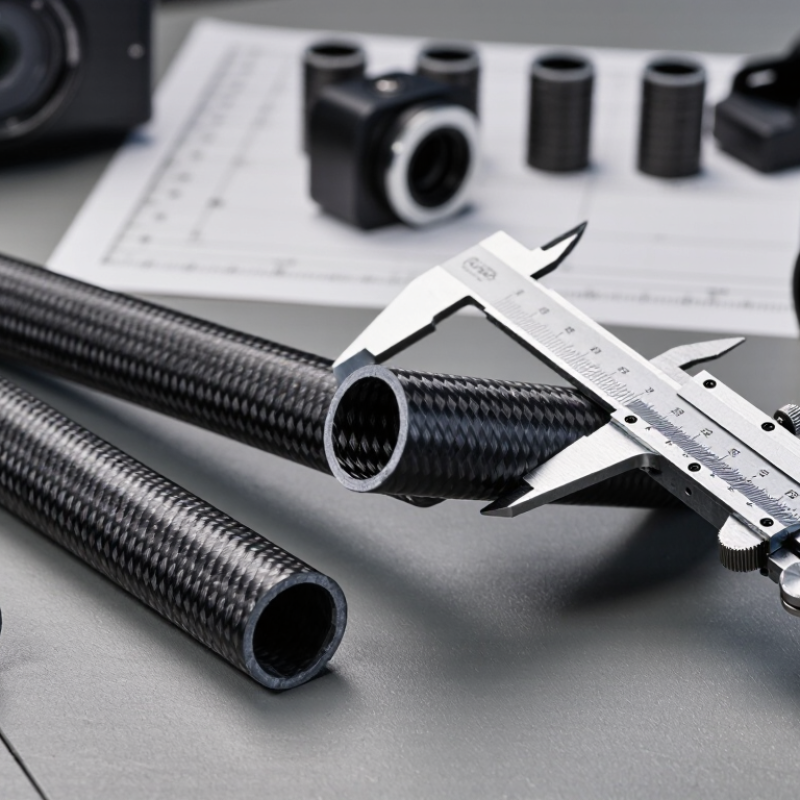
A carbon-fiber tube is a hollow composite structure, not a solid piece of carbon. Fine carbon fibers provide strength and stiffness, while a cured resin binds them into a stable wall. Manufacturers may form tubes by wrapping fabric or aligning continuous fibers around a mandrel. The fiber direction matters: fibers running along the tube help resist bending, while angled layers can improve torsional strength. Small changes in the layup can change performance.
A typical CFRP density is about 1.5–1.6 g/cm³, though the exact value depends on fiber content, resin, and manufacturing quality. This is a useful estimate for comparing materials, not a guaranteed specification. Voids or extra resin can shift the finished tube’s density. For weight estimates, calculate the tube wall’s volume rather than treating the tube like a solid rod. I would verify a supplier’s measured data before designing close to a weight limit. Details matter.
Tips: Check the stated density and wall thickness together. Ask whether figures describe the finished tube or only its raw material. A quick mass check on a sample can reveal differences, though it is not a substitute for proper testing.

A carbon-fiber tube can reduce weight significantly when every gram matters. ASM International materials data place common steel near 7.85 g/cm³, while NASA’s Composite Materials Handbook-17 reports typical carbon/epoxy laminate densities around 1.5–1.6 g/cm³. At equal volume, that is roughly one-fifth the mass of steel. Picture a one-meter tube lifted onto a workbench: a lighter structure can be easier to handle and may reduce the load on nearby supports.
But this comparison is imperfect. Density alone does not tell you whether a tube will resist bending, impact, or crushing. Wall thickness, fiber direction, resin, joints, and manufacturing quality all matter. I still check the actual load case; a light tube is not automatically a suitable one.
Tips: Compare finished tubes, not just raw-material densities. Check dimensions, layup, and supplier test data. For a quick estimate, multiply the tube’s volume by 1.5–1.6 g/cm³ for CFRP, then compare it with steel at 7.85 g/cm³. Treat the result as an estimate, not a design verification.
| Comparison | Carbon Fiber-Reinforced Polymer (CFRP) | Steel |
|---|---|---|
| Typical density | 1.5–1.6 g/cm³ | About 7.85 g/cm³ |
| Mass of 1 liter of material | About 1.5–1.6 kg | About 7.85 kg |
| Mass of 1 m³ of material | About 1,500–1,600 kg | About 7,850 kg |
| Mass at equal material volume | Approximately 19–20% of the steel mass | Reference value: 100% |
| Approximate mass reduction at equal volume | About 80% compared with steel | Baseline for comparison |
| Design consideration | Density and mechanical properties vary with fiber type, fiber orientation, resin, and manufacturing process. | Density and mechanical properties vary by steel grade and product form. |
Note: These figures compare equal volumes of material, not finished tubes with equal strength, stiffness, dimensions, or safety factors. Tube mass depends on its geometry and design.
Why Choose a Carbon Fiber Tube for Your Project?
When a tube must resist bending without adding much weight, stiffness deserves close attention. CFRP elastic modulus commonly ranges from 70 to 300 GPa, but that figure is not a universal property of every tube. Fiber type, resin content, winding angle, and test direction all affect the measured value. The tube’s wall thickness and diameter matter too. A larger diameter can improve bending stiffness substantially, even when the material stays the same.
Check the direction of the quoted modulus. A tube may be very stiff along its fibers yet less resistant to loads across them. For a camera boom or lightweight frame, compare the expected load direction with the tube’s layup and support points. Ask for test data or a datasheet that identifies the measurement method. Numbers need context. A high modulus alone does not guarantee less deflection in your assembly.
In practice, a simple bench test can expose problems early: support the tube at two points, apply a known load, and measure the center deflection. Keep the setup consistent. It is easy to overlook joints; a flexible clamp or loose fitting can dominate the result. I would also leave room for uncertainty, since published ranges can hide meaningful differences between constructions. One detail is easy to miss: impact damage may not be obvious on a dark surface. Check the tube regularly when reliability matters.
Compare typical elastic modulus ranges to evaluate stiffness. A higher modulus means less elastic deformation under the same load and geometry.
CFRP modulus varies widely with fiber type, fiber direction, and laminate design. The chart shows representative ranges: CFRP 70–300 GPa, aluminum alloys 69–72 GPa, and steel 190–210 GPa. Actual values depend on the specific material and test direction.
A carbon fiber tube performs best when its shape and fiber directions match the loads it will carry. A round tube suits many bending and torsion applications, while a rectangular or oval profile can provide useful stiffness along selected axes. Geometry matters. Increasing diameter can improve bending stiffness, but it may also affect fit, weight, and joint design.
Fiber layup shapes how the tube responds. Fibers running lengthwise, often called 0-degree plies, support axial loads and bending. Angled plies, commonly near ±45 degrees, help resist twisting. Circumferential fibers can improve hoop strength under radial pressure. A balanced layup is not automatically the right one. Not always. The best combination depends on load direction, support points, and how the tube connects to the rest of the assembly.
Start with realistic load cases, including vibration and impact if they are expected. Then compare tube dimensions and layup options with supplier data or engineering analysis. Check the finished part, too: cut edges, drilled holes, and clamped joints can create local stress concentrations. A calculation may look tidy, yet a prototype can reveal unexpected flex. Testing under representative conditions is worth the time, even when the first design seems obvious.
Choosing a carbon fiber tube is not only about stiffness and low weight. Check its service limits against the actual environment before selecting a wall thickness. Temperature matters: resin systems differ, and sustained heat can soften the matrix even when the fibers remain strong. Ask for the maximum continuous-use temperature, not just a brief peak rating. A warm enclosure is not always harmless.
Impact needs a separate check. A tube may resist bending yet suffer hidden delamination after a tool drop or sharp-edge strike. Inspect cut ends and high-load areas; a pale mark or sudden change in sound deserves attention. UV exposure can also age some resin surfaces. For outdoor parts, confirm UV resistance and consider a compatible protective coating. Scratches can expose the surface again, so maintenance matters.
Joining can decide whether the design works. Clamps may crush thin walls, while drilled holes can create stress concentrations. Bonded joints need suitable surface preparation, controlled adhesive thickness, and enough cure time. Metal inserts may spread loads, but they add weight and can introduce thermal-expansion differences. Test a sample joint under expected loads and temperatures. I would not assume a neat lab result represents the finished assembly; real installations are often less tidy. Ask for data specific to the tube construction, then verify critical limits in your setup.
We serve the Greater Milwaukee area: Waukesha, Milwaukee, Washington, Ozaukee Counties and nearby areas, including Germantown, Menomonee Falls, Mequon, Cedarburg, Thiensville, Grafton, Jackson, West Bend, Hartland, Waukesha, Brookfield, West Allis, Franklin, Greenfield and more. We are Wisconsin’s Best Contractor for Replacement Windows, Doors, Siding & Roofing!
Address:
N112 W14880 Mequon Road
Germantown, Wisconsin 53022
Phone:
Email:
Monday: 9am – 5pm
Tuesday: 9am – 5pm
Wednesday: 9am – 5pm
Thursday: 9am – 5pm
Friday: 9am – 4:30 pm
Saturday by Appointment
Evenings by Appointment